
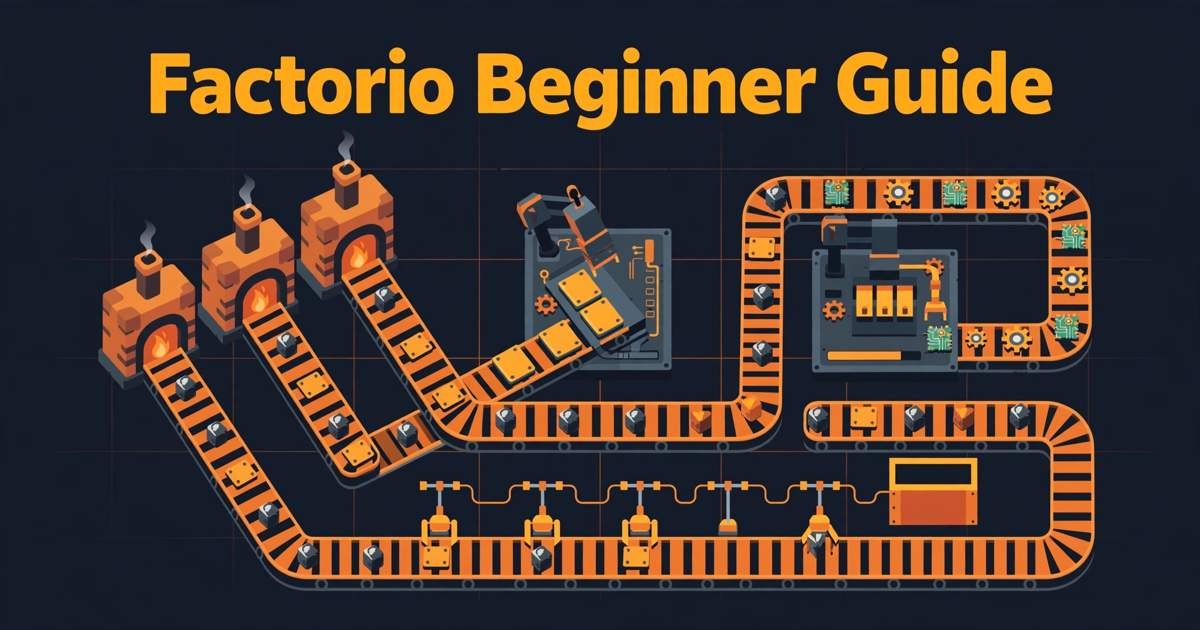
This factorio beginner guide is for players starting vanilla Factorio for the first time. You will learn how to mine and smelt your first resources, build your first automated lines, make steam power, research new technology, and defend your factory, without needing mods, perfect ratios, or a finished mega-base plan.
Contents
- What Is Factorio and What Is Your Goal?
- Your First Hour: Mining, Smelting and Fuel
- How to Set Up Your First Automated Factory
- Powering Your Factory With Steam
- Research, Science Packs and Smarter Machines
- Belts, Inserters and the Main Bus Layout
- Biters, Pollution and Defence Basics
- Common Beginner Mistakes to Avoid
- Your First Rocket: What Comes Next
- Frequently Asked Questions
What Is Factorio and What Is Your Goal?
SUMMARY: In this factorio beginner guide, you gather resources, automate production, research technology, and eventually launch a rocket. In vanilla Factorio, that rocket is the main finish line for a first playthrough.
Factorio, developed by Wube Software, drops you on an alien planet with very little equipment. You mine iron ore, copper ore, coal, and stone by hand at first, then use those materials to build drills, furnaces, belts, and assembling machines. Every new machine makes the next step faster, and that loop, mine, build, automate, expand, is the whole game. The official Factorio website describes it as a game about building and creating automated factories, and that description is accurate: you are not meant to stay a manual crafter for long.
Your early goal is simple: keep your machines supplied and keep production moving. Iron plates and copper plates are the foundation of almost everything you build, so they deserve your attention first. Stone becomes bricks and furnaces, coal becomes fuel, and wood is useful early fuel when you have not yet mined enough coal. This guide covers vanilla Factorio only. It does not assume the Space Age expansion, and it does not rely on mods. If you play on console, the same early steps apply, although controls differ; players using a Switch controller may also find the GameCresta guide on how to fix Joy-Con drift useful if their sticks start misbehaving during long building sessions.
Your First Hour: Mining, Smelting and Fuel
SUMMARY: In this factorio beginner guide, you start by mining by hand, then place a burner mining drill directly into a stone furnace so ore becomes plates automatically. Keep both machines fuelled with wood or coal, and repeat the setup for copper.
When you spawn, look around before you build. You want iron ore, copper ore, coal, and stone reasonably close together, plus water nearby for steam power later. If one resource is very far away, or your starting area has almost no coal, starting a new map is usually faster than struggling with a poor spawn. The official Factorio Wiki quick start guide gives the same practical advice: check that the four solid starting resources are close to your spawn.
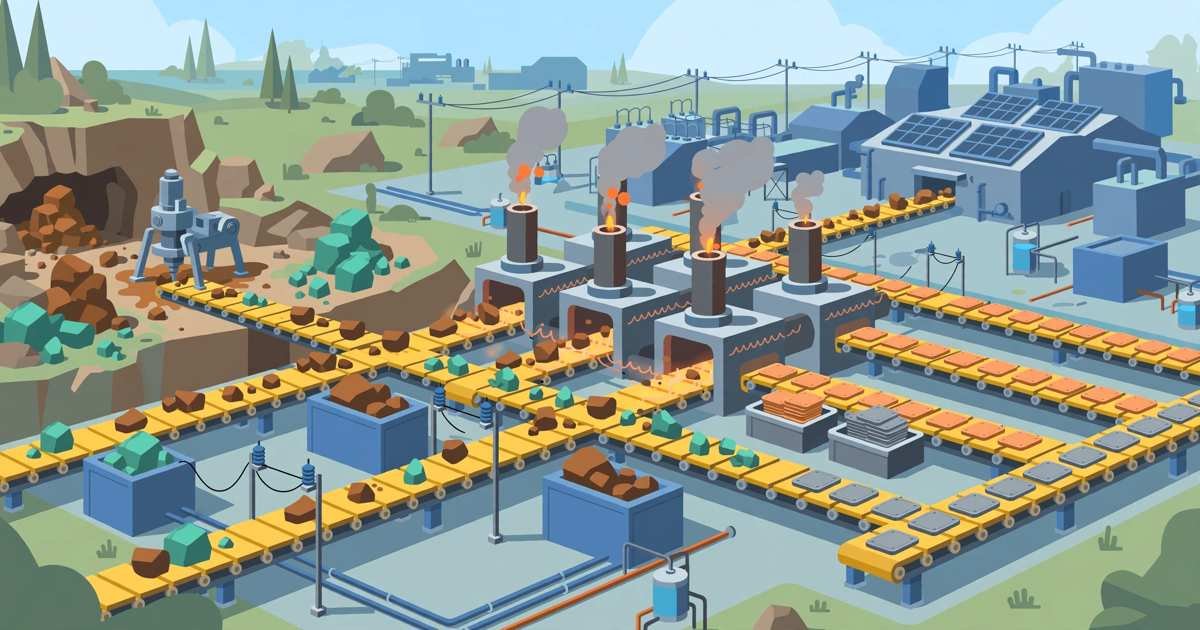
Begin by holding the right mouse button over trees and ore to gather wood, coal, iron ore, and copper ore by hand. Press E to open your inventory and hand-craft your first burner mining drill and extra stone furnaces. Then place a burner mining drill on an iron ore patch, with its yellow output arrow pointing into a stone furnace placed directly in front of it. Add wood or coal to both machines, and the drill will mine ore while the furnace smelts it into iron plates. Build the same pair for copper ore, and you have your first automated production.
How to Set Up Your First Automated Factory
SUMMARY: In this factorio beginner guide, you replace hand-carrying with belts, inserters, and chests so ore flows into furnaces and plates flow out without you standing next to them. Build in straight lines, leave space between production blocks, and expand sideways instead of rebuilding.
A drill feeding one furnace is automation, but it is not yet a factory. Place a belt in front of a drill so ore lands on the belt, then use an inserter to move ore from the belt into a furnace, and another inserter to move plates out of the furnace onto a second belt or into a chest. Burner inserters work early on because they burn fuel themselves, but they also need refuelling, so switch to electric inserters once you have power.
- Build one product per line at first: iron plates on one line, copper plates on another.
- Leave a few tiles of empty space between production blocks for belts and power poles.
- Put a chest at the end of a line only as a buffer, not as your main storage system.
- Use splitters to divide a belt between two lines, and underground belts to cross one belt under another.
Powering Your Factory With Steam
SUMMARY: In this factorio beginner guide, steam power needs water, an offshore pump, a boiler, and steam engines connected by pipes and power poles. One boiler can supply two steam engines, and that small setup powers your first electric drills, inserters, and labs.
Burner machines are useful, but they do not scale. Electric mining drills cover a larger area than burner drills, electric inserters do not need refuelling, and labs and assembling machines need electricity. To make power, place an offshore pump in water, connect it with pipes to a boiler, connect the boiler to steam engines, and place power poles so their coverage areas touch your machines. Fuel the boiler with coal, and the engines will start producing electricity.
The classic starter setup is one offshore pump, one boiler, and two steam engines. That is enough for your first electric drills, inserters, and research labs, and it is easy to copy when you need more power: add another boiler and two more engines, or build a second identical row. If demand rises above supply, machines slow down, so add power before you add a large new production block. Coal supply matters too: if your boiler runs out of coal, your whole electric network stops.
Research, Science Packs and Smarter Machines
SUMMARY: In this factorio beginner guide, research unlocks better machines, and it runs on science packs made in assembling machines and consumed by labs. Start with automation science packs, keep your labs supplied, and research logistics, automation, and steel processing early.
Research is how Factorio opens up. Place labs, put science packs into them, and choose a technology in the research screen. The first science pack, automation science, is made from copper plates and iron gear wheels. Automating that recipe is a milestone: one assembling machine making gear wheels, another making science packs, belts carrying plates in, and inserters feeding packs into labs. Once that loop runs on its own, you are researching while you build elsewhere.
Early technologies that help almost every beginner include logistics, which improves belts and inserters; automation, which improves assembling machines; and steel processing, which unlocks steel. As you unlock new science packs, each one needs a new production line, so plan for extra space around your labs. Electric mining drills are another early upgrade worth prioritising: they mine a larger area and run on your power network instead of needing fuel in each drill.
Belts, Inserters and the Main Bus Layout
SUMMARY: In this factorio beginner guide, the main bus is a set of parallel belts carrying your most-used materials past every production block. It is not the only good layout, but it is the easiest one for a beginner to understand, expand, and repair.
Once iron plates, copper plates, steel, and circuits are moving, you need a way to share them between many machines. The main bus runs several belts in parallel, usually iron plates, copper plates, and later steel and green circuits, with production blocks built to one side. Each block pulls what it needs from the bus with splitters and underground belts. The main bus works because it is predictable: if iron plates run low everywhere, the problem is in smelting; if only one block is starved, the problem is in that block’s connection.
Biters, Pollution and Defence Basics
SUMMARY: In this factorio beginner guide, biters attack because your factory produces pollution, and pollution spreads from furnaces, boilers, and drills. Use gun turrets with ammunition, wall off key areas, and clear nearby nests before they grow.
Factorio’s enemies, usually called biters, are not random. Your machines produce pollution, pollution drifts across the map, and when it reaches an enemy nest, biters may be sent to attack the source. Early furnaces and boilers are major pollution sources, so a large, inefficient factory attracts more attention than a small, tidy one.
For defence, start simple: place gun turrets near your smelting area and power plant, and keep them supplied with magazines, by hand at first or with a belt and inserter later. A wall without turrets behind it only delays an attack. Repair packs and a personal weapon help you respond to an early attack, and clearing a nest close to your base removes that source of attacks. If combat feels overwhelming on a first run, peaceful mode is a valid choice: enemies do not attack unless you attack first.
Common Beginner Mistakes to Avoid
SUMMARY: In this factorio beginner guide, most beginner problems come from building too tightly, hand-crafting too much, and expanding without fixing supply first. Leave space, automate basic items early, and fix the bottleneck at its source.
- Building too tightly: leave space for extra belts, poles, and furnaces.
- Hand-crafting everything: automate repeated items in an assembling machine.
- Adding machines instead of fixing supply: if furnaces lack ore, add drills first.
- Mixing items on one belt: one belt should carry one item.
- Ignoring research: keep labs running whenever possible.
Your First Rocket: What Comes Next
SUMMARY: In this factorio beginner guide, after the early game you scale up plates and circuits, unlock oil processing and advanced science, build a rocket silo, and launch a rocket with a satellite. A steady, well-supplied factory reaches the rocket more reliably than a rushed one.
Beyond early science, oil processing adds plastics and fuel, and advanced circuits need much more plate and circuit production. If your bus belts are empty, expand mining and smelting first. Finally, build the rocket silo, supply its rocket parts, and launch a rocket carrying a satellite to complete the vanilla goal. For more gaming guides and news, visit the GameCresta homepage.
| Stage | Focus | Check before moving on |
|---|---|---|
| First hour | Ore, plates, fuel | Iron and copper plates flowing |
| Automation | Belts and inserters | Plates move without hand-carrying |
| Power | Steam engines | Power supply exceeds demand |
| Research | Science packs | Labs supplied automatically |
| Endgame | Oil and rocket silo | Bus belts stay full |
Frequently Asked Questions
SUMMARY: In this factorio beginner guide, these answers cover the questions new Factorio players ask most often, from difficulty and game length to mods, peaceful mode, and multiplayer.
Is Factorio hard for beginners?
Factorio has a learning curve, but it is gentle if you go step by step. Use the in-game tutorial, follow this factorio beginner guide, and expect your first factory to be messy.
How long does it take to finish Factorio?
A first vanilla playthrough to a rocket launch can take many hours, varying with experience and map settings. Play in sessions, build one system at a time, and do not treat the rocket as a deadline.
Should beginners use mods in Factorio?
For a first playthrough, vanilla Factorio is best. Mods can change recipes and hide the lessons the base game teaches. Learn vanilla first, then use mods to replay with new challenges.
What is the best starting setup in Factorio?
Use a burner mining drill feeding a stone furnace for iron, the same pair for copper, and wood or coal for fuel. Then add belts, inserters, and a small steam setup with an offshore pump, a boiler, and two steam engines.
Do I need to fight biters in Factorio?
Biters are part of the default game, because pollution attracts them, but turrets, walls, and clearing nearby nests reduce the pressure. Peaceful mode is also valid if you want to learn building first.
Can I play Factorio multiplayer as a beginner?
Yes. Agree on a simple shared plan first, such as one main bus and named production areas, so players do not build competing factories on top of each other. A short solo game first also helps.
For More Updates Visits : GAME CRESTA




2 Responses