
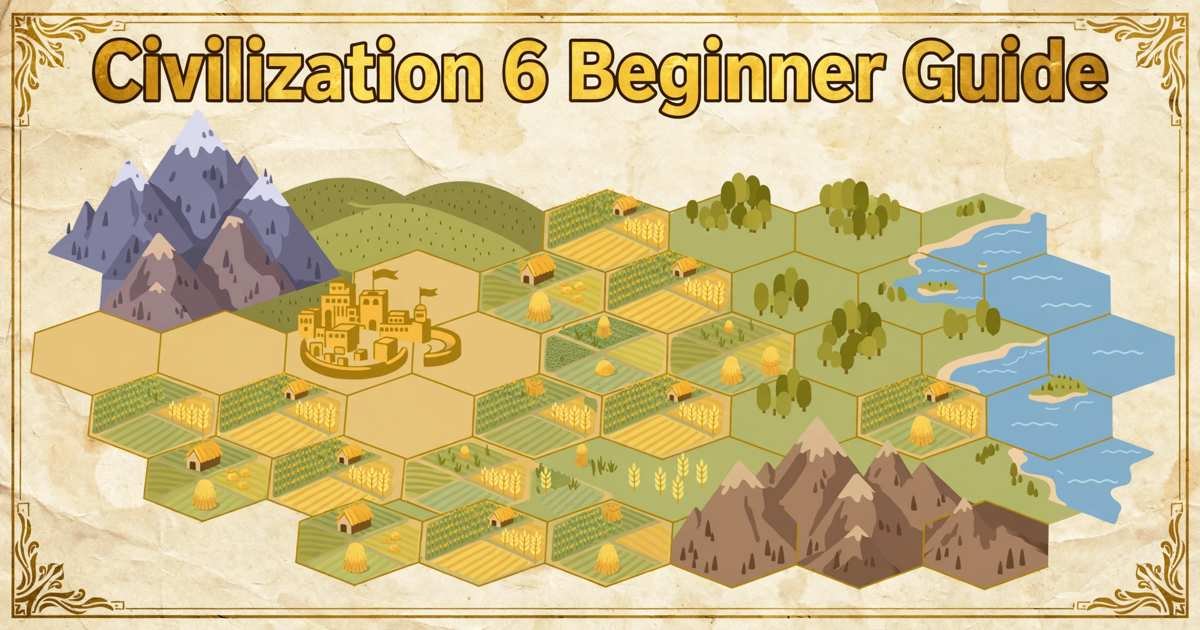
This civilization 6 beginner guide explains the game in plain language, with no assumed knowledge. Civilization VI is a turn-based strategy game in which you lead a civilization from a single settler in 4000 BC through thousands of years of history, building cities, researching technology, meeting other leaders and choosing how you want to win.
That freedom is also what makes the first game confusing, because many systems run at once and the game rarely tells you which choice matters most. This guide gives you one clear plan: a forgiving first civilization, a simple opening, a sensible number of cities and the district rules that quietly decide most games.
Contents
- What Is Civilization 6 and How Does a Game Work?
- Choose Your First Civilization: Why Rome Is the Best Beginner Pick
- Your First 50 Turns: A Simple Opening Plan
- Cities, Districts and Adjacency: The Core System to Learn First
- Science, Culture, Gold and Faith: Yields Explained
- Diplomacy, War and Winning Without Fighting Everyone
- Expansions as Core: Rise and Fall and Gathering Storm Changes for Beginners
- Common Beginner Mistakes and How to Fix Them
- A Simple Checklist for Your First Full Game
- Frequently Asked Questions
What Is Civilization 6 and How Does a Game Work?
SUMMARY: Civilization VI is a turn-based strategy game where you grow cities on a hexagonal map, research technology and civics, and win by science, culture, domination, religion, diplomacy or score.
Each game is played on a map made of hexagonal tiles. You found cities, improve the land around them with builders, place districts on tiles and move units one turn at a time. There is no real-time pressure, so you can read every tooltip and check what a button does before you end your turn. Use that slow pace.
A standard game has a turn limit, usually 500 turns on Standard speed, and several ways to win before that limit. You do not need to defeat everyone to win. Most beginner games are lost not by war, but by falling behind in science or culture while trying to do everything at once. Pick one direction early, then support it with cities and districts.
Do not confuse Civilization VI with Civilization VII. They are different games with different rules. Civilization VI does not use Civilization VII’s system of separate Ages in which you change civilization, and it does not use its legacy-path structure. In Civilization VI you keep the same leader and civilization for the whole game.
| Victory type | How you win |
|---|---|
| Science | Launch a satellite, land on the Moon, build a Mars colony and complete the exoplanet expedition. |
| Culture | Attract more visiting tourists than any rival has domestic tourists. |
| Domination | Capture the original capital of every other civilization. |
| Religious | Make your religion the majority in every other civilization. |
| Diplomatic | Earn 20 Diplomatic Victory points, mainly through the World Congress in Gathering Storm. |
| Score | Have the highest score when the turn limit is reached. |
Choose Your First Civilization: Why Rome Is the Best Beginner Pick
SUMMARY: Rome is the best beginner civilization in Civilization VI because its bonuses help every city from the start, without forcing you into one narrow strategy.
Rome, led by Trajan, is forgiving in exactly the ways a beginner needs. Every city you found starts with a free Monument in the early game, which gives you culture from that city’s first turn. Roads to your capital are built automatically as you expand, and trade routes passing through Roman cities bring extra gold. None of this needs a special tactic to activate; it simply makes a normal, sensible game stronger.
Rome also has useful military and infrastructure tools. The Legion is a strong early melee unit that can also build roads and forts, and the Bath replaces the Aqueduct, giving extra housing and amenities to help cities grow larger. For official information, see the official Civilization VI page and the Firaxis Games site.
- Start with Rome for your first two or three full games, so you learn the systems rather than a new leader’s quirks.
- Play on Prince difficulty or lower and use a Standard-size map at Standard speed, so mistakes are recoverable and the game feels manageable.
Your First 50 Turns: A Simple Opening Plan
SUMMARY: In your first 50 turns, explore with a scout, defend with a slinger, settle a second city on a good site, and start the monuments and districts that will carry your science and culture.
Your first city should usually settle where you start, unless the starting tile is clearly poor. Look for fresh water from a river or lake, because housing limits how large a city can grow, and for a mix of food and production nearby. A city with food but no production builds slowly; a city with production but little food struggles to work its best tiles. You want both.
Send your first warrior or scout outward to reveal the map, meet city-states and find good places for your next cities. Build a scout early if you can, then a slinger for defence, because barbarian camps can send raiding parties toward undefended cities. After that, aim for a settler once your capital is producing reasonably well. Do not wait until turn 100 to settle your second city.
- Turns 1 to 15: Explore, improve your best tiles, and watch for barbarian scouts.
- Turns 15 to 35: Train a slinger and a settler, choose a second city site with fresh water, and clear threatening barbarian camps.
- Turns 35 to 50: Settle the second city, start a key district in your capital, and send a trade route for gold and food.
Cities, Districts and Adjacency: The Core System to Learn First
SUMMARY: Districts are specialized neighborhoods placed on tiles outside a city center, and their output grows when they sit next to the right terrain, wonders and other districts.
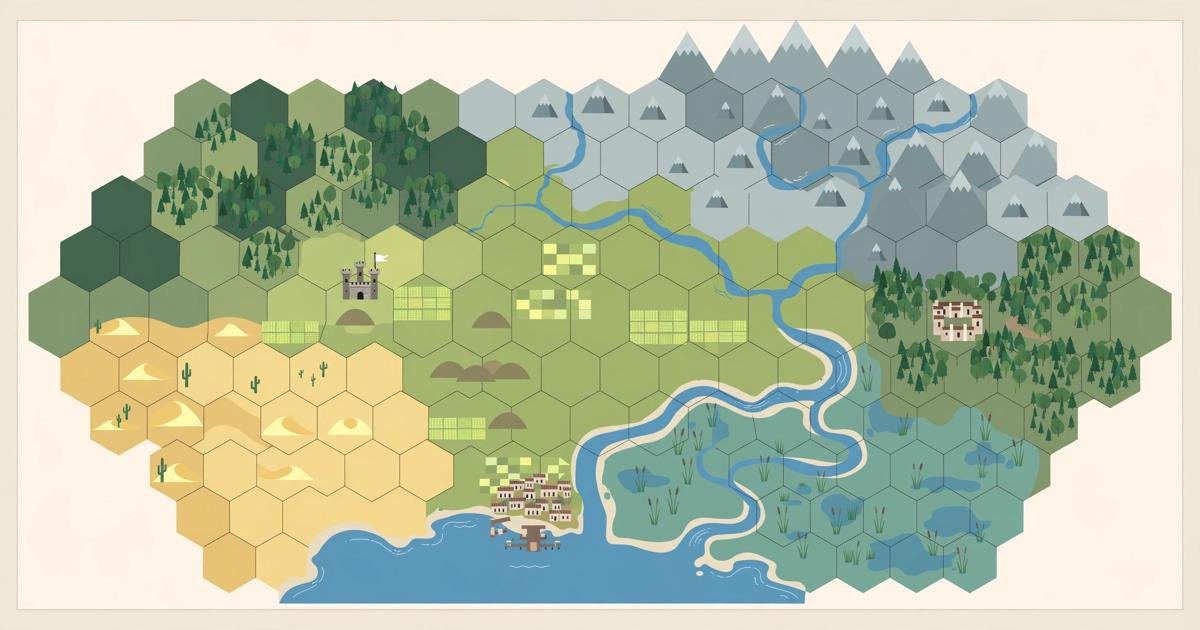
A district takes a tile around a city and turns it into a campus, theater square, commercial hub or another specialist area. Each district then unlocks buildings, such as a library in a campus or a market in a commercial hub, which increase its output further.
Adjacency is the key idea. Before you place a district, the game shows a preview of its adjacency bonus. A campus next to mountains is stronger than the same campus on flat, empty land. You do not need to memorize every bonus on day one. You need the habit of checking the preview, placing districts next to helpful terrain and wonders, and not wasting a high-value tile on a district that gains nothing from it.
| District | Place it next to | What it helps |
|---|---|---|
| Campus | Mountains, rainforest and other districts | Science |
| Theater Square | Wonders and districts | Culture |
| Commercial Hub | Rivers and harbors | Gold and trade routes |
| Holy Site | Mountains, woods and natural wonders | Faith |
| Industrial Zone | Mines, quarries and districts | Production |
| Encampment | Borders you may need to defend | Military production and defence |
As a beginner target, aim for around eight cities by the middle of a game, rather than trying to settle everywhere or stopping at three. Eight cities give you enough districts and trade routes to compete, without spreading your builders, armies and attention so thin that every city is weak. The exact number depends on map size and available land, so treat eight as a guide, not a rule.
Science, Culture, Gold and Faith: Yields Explained
SUMMARY: Yields are the resources your cities produce each turn, and science and culture unlock new options while gold and faith let you buy or support them.
- Science unlocks new technologies, from writing to rocketry.
- Culture unlocks new civics, governments and policy cards.
- Gold pays for upkeep, buys tiles, and purchases units and buildings quickly.
- Faith can found and spread a religion and buy religious units.
- Production builds everything, so a low-production city always feels slow.
- Food and housing let cities grow and work more tiles.
Diplomacy, War and Winning Without Fighting Everyone
SUMMARY: You can win Civilization VI without constant war by trading, keeping friendly neighbours, defending well and choosing wars only when they clearly help your plan.
Other leaders judge you by your actions. Settling very close to them, breaking promises and declaring surprise wars will damage relations and can lead to joint wars against you. Trading, sending delegations, keeping promises and helping in emergencies usually keeps the map calmer. City-states are also worth befriending: sending envoys gives you bonuses, and becoming their suzerain gives a stronger bonus and, in war, their units.
War still has a place, but for a beginner it should be deliberate. Attack when you have a clear target, a stronger army and a reason, such as removing a threat. Do not declare war because you are bored, and do not leave a city undefended while your whole army is elsewhere. A small standing army, walls in border cities and a ranged unit in a city center deter many attacks on their own.
Expansions as Core: Rise and Fall and Gathering Storm Changes for Beginners
SUMMARY: With both expansions, loyalty, governors, eras, the World Congress and climate shape your game, so learn those systems as part of the base game, not as extras.
Rise and Fall adds loyalty, which can make cities near a stronger civilization flip to it, and governors, who give a city special bonuses. It also adds era score: strong play can earn a Golden Age with extra bonuses, while weak play can bring a Dark Age. Gathering Storm adds the World Congress, diplomatic favor, natural disasters, climate change and power for later buildings. Keep cities loyal by settling close together, use governors in your most important cities, and do not ignore diplomatic favor, because World Congress votes can help or hurt you.
Common Beginner Mistakes and How to Fix Them
SUMMARY: Most beginner losses come from too few cities, ignored districts, no defence and chasing every goal at once, and each of those has a simple fix.
- Too few cities: Settle early and aim for around eight cities.
- Districts placed without checking adjacency: Always read the preview before placing a district.
- No army until war starts: Keep a few units and walls in border cities, even in a peaceful game.
- Researching everything: Follow one victory path first.
- Ignoring amenities and housing: Build entertainment, luxuries and housing improvements, or growth will stall.
A Simple Checklist for Your First Full Game
SUMMARY: Use this short checklist at the start of each era to stay on track, and you will finish your first game with a clear sense of what to improve next time.
- Play Rome, on Prince or lower, on a Standard map at Standard speed.
- Explore, defend, settle a second city early, and work toward around eight cities.
- Place each district for adjacency, then add its key buildings.
- Trade, keep promises, befriend city-states and keep a small defensive army.
- Pick one victory type, check progress each era, and adjust policy cards to match.
If you enjoy this kind of slow, systems-rich strategy, you may also like our Crusader Kings 3 Beginner Guide, our Satisfactory Beginner Guide and our Factorio Beginner Guide. You can find more guides on the Game Cresta homepage.
Frequently Asked Questions
SUMMARY: These short answers cover the questions new Civilization VI players ask most, from the best first civilization to how many cities to build.
What is the best civilization for beginners in Civilization 6?
Rome is the best beginner pick, because its free monuments, automatic roads and extra gold help every city without forcing one strategy.
How many cities should a beginner build in Civilization 6?
Aim for around eight cities by the middle of the game, adjusting for map size and available land.
What should I build first in Civilization 6?
Explore first, then add defence, a builder and a settler, so your second city is founded early rather than late.
What are districts and why does adjacency matter?
Districts are specialist areas on tiles outside a city center, and adjacency bonuses from terrain, wonders and other districts increase their output.
Do I need the expansions to enjoy Civilization 6?
No, but this guide treats Rise and Fall and Gathering Storm as core, because loyalty, governors, the World Congress and climate change the game significantly.
Is Civilization 6 the same as Civilization 7?
No. Civilization VI keeps the same leader and civilization all game, while Civilization VII uses a different Ages and civilization-switching structure.
Final Thoughts
SUMMARY: Start with Rome, settle early, place districts for adjacency and pick one victory path, and your first Civilization VI game will teach you the rest.
For More Updates Visits : GAME CRESTA





One Response