Rust Beginner Guide: Your First Wipe, From Rock and Torch to a Locked 2×1
First things first: this is a guide to Rust the survival game by Facepunch, not the Rust programming language. If you searched for code, you are in the wrong place. If you searched for a brutal multiplayer survival game where you wake up on a beach holding a rock, welcome home — this rust beginner guide takes you from that first rock to a locked base of your own.
Rust is a multiplayer-only survival game on Steam, priced at $39.99, and it does not hold your hand. There is no tutorial, no quest log and no safe zone, and other players can raid your base and steal your loot. That sounds harsh — but it is what makes your first base feel like a real achievement.
Table of Contents
What Is Rust?
Before You Spawn
Your First Hour
Your First Base: A Locked 2×1
Scrap and Blueprints
Food, Health, and Staying Alive
Your First Wipe
Common Beginner Mistakes
Rust Beginner Guide FAQs
What Is Rust? The Survival Game, Not the Programming Language
SUMMARY: Rust is Facepunch’s multiplayer survival game; this rust beginner guide explains the name confusion and the core loop.
Search results mix the two up constantly, so let us clear it up right away. Rust the game is a multiplayer survival game made by Facepunch, the studio behind Garry’s Mod. Rust the programming language is a systems language used by software developers. They share a name and nothing else — no coding in this game, and no base-building in that language. Everything in this rust beginner guide is about the game.
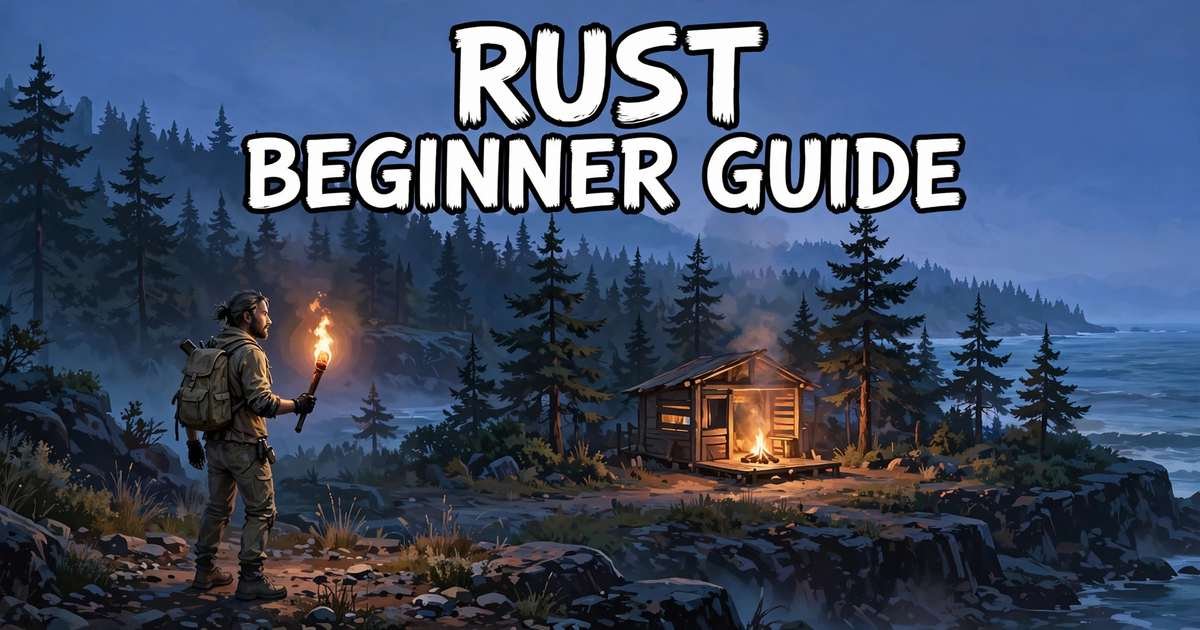
This rust beginner guide starts where every Rust player starts: you spawn on a procedurally generated island with nothing but a rock and a torch. You gather wood and stone, craft basic tools, and build a small base. The island is shared with dozens of other players, and everyone is a potential friend, trader or raider. There is no single-player mode: when you log off, your character sleeps where you left them, and the monthly wipe resets the map so everyone starts over together.
Before You Spawn: What You Need to Know
SUMMARY: Rust is multiplayer-only and costs $39.99 on Steam; this rust beginner guide covers picking your first server.
Rust costs $39.99 on Steam and is multiplayer-only, so you need a stable internet connection. Before you buy, check the Steam store page for Rust for the latest system requirements, and the official Rust wiki is the reference the community trusts.
Your first big decision in this rust beginner guide is the server. For your first wipe, pick a low-population server with a friendly-sounding name — community servers labelled for beginners, or a low-population official server, are far kinder classrooms than a packed server full of veteran raiders. A quiet server gives you room to learn how to farm, build and craft without someone knocking your door down ten minutes in. You will die in your first wipe, probably more than once. Everyone does — but the players who stick with Rust treat each death as a lesson and go again a little smarter. Bookmark this rust beginner guide — we will update it when the next Rust update lands.
Your First Hour: Rock, Torch, and Your First Tools
SUMMARY: Your rock and torch are your first tools; this rust beginner guide covers the Stone Hatchet and Stone Pickaxe.
You wake up on the beach with a rock in one hand and a torch in the other, and those two items are your entire toolkit. The rock is your first gathering tool: hit trees for wood and hit rock nodes for stone. The torch is your light and warmth — keep it lit when the sun goes down. Do not rush off looking for a fight — your first hour is about gathering, not glory.
Your first crafting goal in this rust beginner guide is a Stone Hatchet and a Stone Pickaxe. Each one costs 200 wood and 100 stone, so a short gathering run gets you both — this rust beginner guide’s first milestone. The hatchet gathers wood faster and the pickaxe gathers stone faster, and together they turn the slow early grind into something that actually moves. While you gather, grab cloth from hemp plants: a sleeping bag needs 30 cloth and becomes your respawn point. Keep an eye on your hunger bar too, and eat what you find — mushrooms, pumpkins and corn grow around the map.

Your First Base: Building a Locked 2×1
SUMMARY: Your first base in this rust beginner guide should be a small, locked 2×1 with a Tool Cupboard inside.
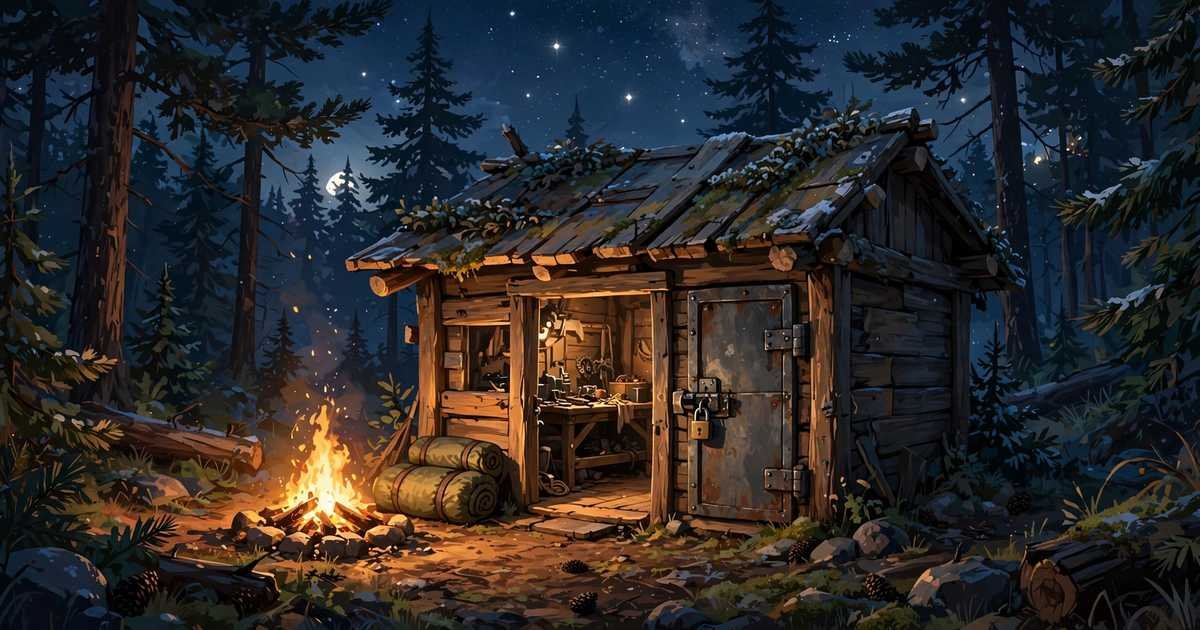
Once you have tools and a sleeping bag, this rust beginner guide says it is time to build. Your first base should be a 2×1: two foundations wide, one deep, with walls, a roof and a door you can lock. It is small, cheap and quick to build, and it gives you a safe box for your loot and a place to respawn. Do not try to build a castle on day one: a small locked box beats a big open ruin every time.
The single most important item in your base, and in this rust beginner guide, is the Tool Cupboard. Place it inside your base and fill it with wood and stone, and it claims the land around your base so other players cannot build right on top of you. It also pays the upkeep that keeps your base standing: without resources inside, your walls slowly decay. Top it up after every farming run. Then lock your door, place your sleeping bag inside, and put a campfire down for cooking and warmth.
Scrap, Workbenches, and the New Blueprint System
SUMMARY: Scrap buys your Tier 1 Workbench for 50 scrap; since the November 5, 2026 update, blueprints pay for tech tree unlocks.
Scrap is the currency of progression in Rust, found in barrels, crates and roadside loot. Your first big purchase in this rust beginner guide is the Tier 1 Workbench, which costs 50 scrap. The workbench unlocks better recipes and access to the tech tree, where you unlock new items permanently for the wipe.
On November 5, 2026, the “Printed and Polished” update reworked how blueprints work, and this rust beginner guide follows the new system. Tech tree unlocks no longer cost scrap at all. Each node costs one blueprint item: a Fragment for Level 1 and Engineering, a Page for Level 2, and a Book for Level 3.
Fragments turn up in everyday loot, and this rust beginner guide treats them as free progress. Pages come from puzzle rooms at monuments and harder content. Books cannot be crafted. You can upgrade 10 fragments into 1 page, but pages cannot become books. Workbenches cost scrap again — 50, 500 and 1,250 scrap for Tiers 1, 2 and 3 — and the research table charges 20–300 scrap by item.
| Item | Cost | What it unlocks |
|---|---|---|
| Tier 1 Workbench | 50 scrap | Level 1 tree |
| Tier 2 Workbench | 500 scrap | Level 2 tree |
| Tier 3 Workbench | 1,250 scrap | Level 3 tree |
| Research table use | 20–300 scrap | Unlock a looted item |
Food, Health, and Staying Alive
SUMMARY: Hunger and health drain constantly, so this rust beginner guide covers food and the habits that keep you alive.
Rust never stops draining you. Your hunger bar falls all the time, your health falls when you are hungry, cold or hurt, and the island is full of things that want to make it worse. The good news is that staying alive as a beginner is mostly about small, boring habits done consistently — the least glamorous lesson in this rust beginner guide.
Eat before you are starving. Wild food grows all over the map: pumpkins, corn and mushrooms are free once you spot them. Cook raw meat at your campfire, and carry a little food on every run. Keep your torch handy at night, and remember your sleeping bag is your safety net. The other survival skill is knowing when to walk away: if you hear gunfire or a fight is going badly, leaving with your loot is a win. If you enjoy learning survival games the slow, steady way, this rust beginner guide recommends our Vampire Survivors beginner guide and our Don’t Starve Together beginner guide too.
Your First Wipe: How Force Wipe Works
SUMMARY: Force wipe, the monthly reset at the heart of this rust beginner guide, lands on the first Thursday of every month around 19:00 UTC.
Every Rust player lives by the wipe cycle, and understanding it early helps. Force wipe happens on the first Thursday of every month, at around 19:00 UTC. When it lands, the map resets and blueprints are usually reset too, so the whole server starts over together. Your base, your loot and your learned blueprints are gone — and so is everyone else’s.
That monthly reset is the best thing about Rust for a beginner — ask any reader of this rust beginner guide. No matter how far behind you feel mid-wipe, the next force wipe puts you back on equal footing with the veterans. Plan around it: if you join two days before wipe day, treat it as a practice run, and start your real attempt on fresh wipe day. And if you are still building when wipe day arrives, do not panic — enjoy the fresh start.
Common Beginner Mistakes to Avoid
SUMMARY: Most beginner deaths come from a handful of avoidable mistakes; this section lists them.
Most new Rust players make the same handful of mistakes, and this rust beginner guide lists the ones to watch for:
- Building too big, too soon. A giant base eats all your wood and stone and still falls to a raid. Start with a locked 2×1.
- Forgetting the Tool Cupboard. No cupboard means anyone can build next to you, and no upkeep means your base decays.
- Leaving doors unlocked. An unlocked door is an invitation — lock every door, every time.
- Carrying everything at once. If you die with a full inventory, you lose it all. Bank scrap and loot at base between runs.
- Trusting strangers too fast. Some players are friendly, and some are waiting for you to open your door. Keep your base locked.
- Ignoring the wipe date. Joining days before force wipe and building a big base is a recipe for heartbreak. Start fresh on wipe day.
- Following pre-November 5 blueprint advice. Old guides tell you to spend scrap on the tech tree. Since the November 5, 2026 update, tech trees cost blueprint fragments, pages and books instead — the current system this rust beginner guide follows.
If you like this rust beginner guide’s slow, steady approach, our Deep Rock Galactic beginner guide covers another co-op game where preparation matters more than reflexes.
Rust Beginner Guide FAQs
SUMMARY: These six questions cover what new Rust players ask most.
Is Rust the game or the programming language?
Rust the game is Facepunch’s multiplayer survival game, and Rust the programming language is a coding language — they only share a name. This rust beginner guide is about the game.
How much does Rust cost?
Rust costs $39.99 on Steam. It is multiplayer-only, so there is no single-player mode and no offline play.
When is the Rust force wipe?
Force wipe is on the first Thursday of every month, at around 19:00 UTC. The map and blueprints usually reset, so the whole server starts over together. This rust beginner guide recommends starting right after a wipe.
What should I build first in Rust?
Build a small, locked 2×1 base with a Tool Cupboard inside, a locked door, a campfire and a sleeping bag. Expand later.
How do blueprints work in Rust now?
Since the November 5, 2026 “Printed and Polished” update, tech tree nodes cost blueprint items instead of scrap: a Fragment for Level 1 and Engineering nodes, a Page for Level 2, and a Book for Level 3. Ten fragments upgrade into 1 page; books cannot be crafted. Workbenches cost scrap again — 50, 500 and 1,250 scrap.
Is Rust worth playing as a beginner in 2026?
Yes, if you enjoy learning by doing and can handle losing your loot sometimes. The monthly force wipe gives beginners a fresh start alongside veterans, and a low-population server gives you room to learn. Start small, build your locked 2×1, and give yourself a full wipe before you decide — this rust beginner guide’s honest verdict.
For More Updates Visits: GAME CRESTA