
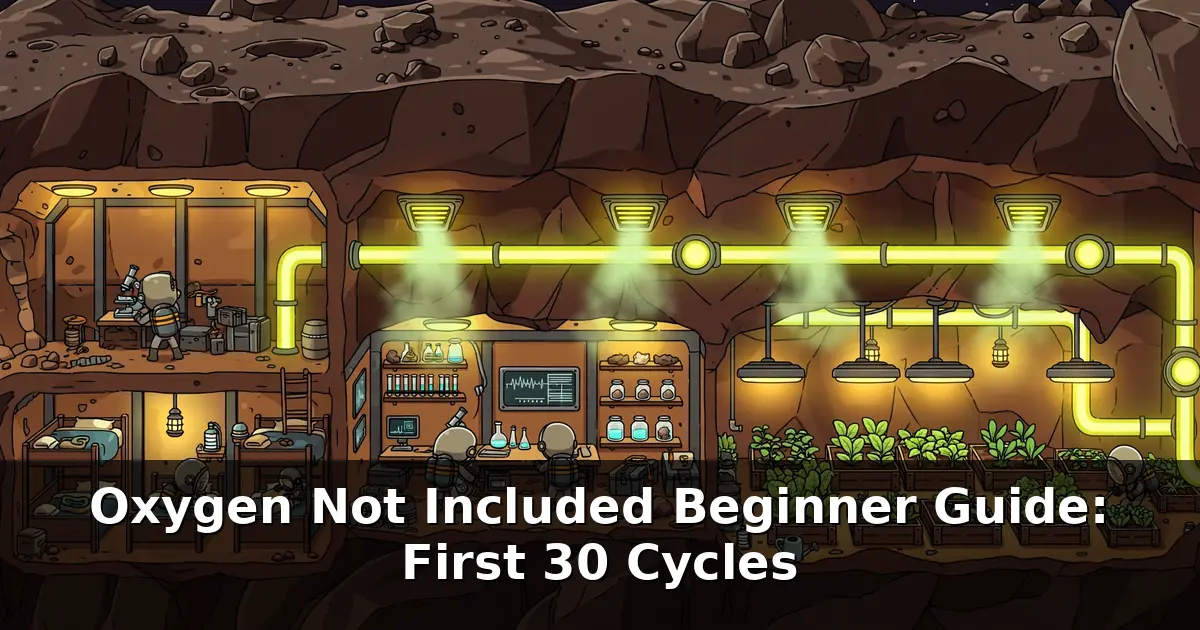
Surviving your first month in Klei Entertainment’s colony sim means solving three problems in order: air, food, and stress. This oxygen not included beginner guide follows one colony from its first three duplicants through cycle 30, ending with a base that breathes, eats, and researches steadily.
The plan is deliberately slow. New players usually fail by expanding too fast. This oxygen not included beginner guide does the opposite, keeping the colony small.
Table of Contents
SUMMARY: Quick jumps to every part.
- Scope
- Duplicants
- Cycles 1-5
- Oxygen
- Food
- Research Order
- Stress and Morale
- Cycles 6-30
- DLCs
- FAQs
What This Guide Covers (and What It Does Not)
SUMMARY: This section sets the scope of this oxygen not included beginner guide: base game only, first 30 cycles.
Oxygen Not Included is a Klei Entertainment colony sim: three cloned workers, called duplicants, dig, build, and survive inside an asteroid. The full game left early access in 2019; systems below were checked against community guides and the wiki in November 2026.
This guide stops at cycle 30: steady oxygen, a farm, basic power, research underway. This oxygen not included beginner guide therefore skips rockets and late-game industry.
Picking Your First Three Duplicants
SUMMARY: This section explains how to judge starting duplicants in this oxygen not included beginner guide: interests first, harmful traits avoided, roles covered.
You start by choosing three duplicants, and this choice matters more than any single building. Look for interests matching the jobs you need most: digging, building, researching.
Avoid harmful traits. Mouth Breather doubles oxygen use, from about 100 grams per second to 200. Narcoleptics fall asleep on the job, Loud Sleepers disturb everyone nearby, Flatulent duplicants pollute the base. This oxygen not included beginner guide recommends re-rolling the trio until none carries a trait that fights your oxygen or sleep.
Duplicant roles table (Role | Interest | Why first): Researcher | Research | Unlocks buildings. Digger/Builder | Digging, Building | Opens space fast. Farmer/Cook | Farming, Cooking | Farm, kitchen.
| Role | Interest | Why first |
|---|---|---|
| Researcher | Research | Unlocks buildings |
| Digger/Builder | Digging, Building | Opens space fast |
| Farmer/Cook | Farming, Cooking | Farm, kitchen |
Welcome Diver’s Lungs (about 75 grams of oxygen per second) and Iron Gut (helps with poor food). Start the researcher on cycle 1.
Cycles 1-5: Building the First Base
SUMMARY: This section covers the first five cycles in this oxygen not included beginner guide: the rooms to build first, in the order that keeps duplicants fed, rested, and clean.
On cycle 1, build: an outhouse, a wash basin, three cots, a manual generator, a battery, a research station. Put the outhouse and wash basin together so duplicants wash hands after using the toilet – unwashed hands spread germs to food and water.
Dig carefully at first. Your starting area holds breathable oxygen pockets, shown in blue on the overlay, plus oxylite that releases oxygen on its own. Dig toward the blue areas for room, and leave carbon dioxide – which sinks to the bottom of your base – where it cannot smother bedrooms. This oxygen not included beginner guide keeps the first dig small on purpose.
- Cycle 1: outhouse, wash basin, three cots, manual generator, battery, research station.
- Cycles 2-5: dig rooms, build storage, plant boxes, start mealwood, add terrariums.
Oxygen: From Algae to the Electrolyzer
SUMMARY: This section explains the oxygen ladder in this oxygen not included beginner guide: stored oxygen, algae, then electrolyzer.
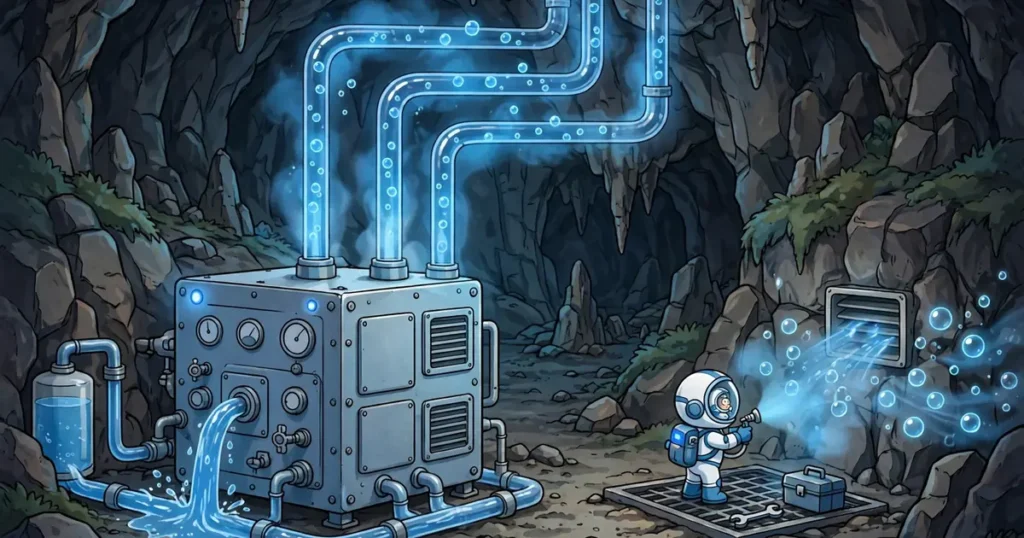
Every duplicant breathes about 100 grams of oxygen per second, so three need roughly 300 grams per second before leaks. Starting air runs out; the first machine to build is the Oxygen Diffuser, which turns algae and power into oxygen.
The Oxygen Diffuser consumes 550 grams of algae per second and produces 500 grams of oxygen per second at 120 watts, and stops when gas pressure around it reaches about 1.8 kilograms per tile. One diffuser theoretically supports five or six duplicants, but stalls without airflow.
Algae Terrariums are the cheaper supplement: no power, algae and water in, about 40 grams of oxygen per second out each, or 44 under light. They cannot carry a colony alone – roughly three per duplicant – but they scrub carbon dioxide well. Treat algae as limited: refinable from slime later, but not infinite, which is why this oxygen not included beginner guide moves you toward the electrolyzer.
The Electrolyzer is the long-term answer: it splits 1 kilogram of water per second into 888 grams of oxygen and 112 grams of hydrogen, enough for up to eight duplicants with steady water and power.
It needs research first, plus pumps and pipes for water and gas, and the hydrogen must be handled – collected or vented safely – or it will make the air unbreathable. Build it high in your base, away from farms: it produces heat. This oxygen not included beginner guide recommends switching only with a reliable water source; until then, algae carries you.
Oxygen sources table (Oxygen source | Input | Output | Best use): Oxygen Diffuser | Algae, 120 W | 500 g/s oxygen | Main early supply. Algae Terrarium | Algae, water, no power | 40 g/s (44 lit) | Scrubbing, outposts. Electrolyzer | Water, power, research | 888 g/s oxygen | Long-term supply.
| Oxygen source | Input | Output | Best use |
|---|---|---|---|
| Oxygen Diffuser | Algae, 120 W | 500 g/s oxygen | Main early supply |
| Algae Terrarium | Algae, water, no power | 40 g/s (44 lit) | Scrubbing, outposts |
| Electrolyzer | Water, power, research | 888 g/s oxygen | Long-term supply |
Food: Mealwood First, Then Better Meals
SUMMARY: This section covers the food ladder in this oxygen not included beginner guide: starting rations, wild food, and the first farm.
You begin with about 20,000 kilocalories of rations, which disappears fast once three duplicants work hard. While digging, collect wild food – muckroots, bristle berries, meal lice – as a stopgap.
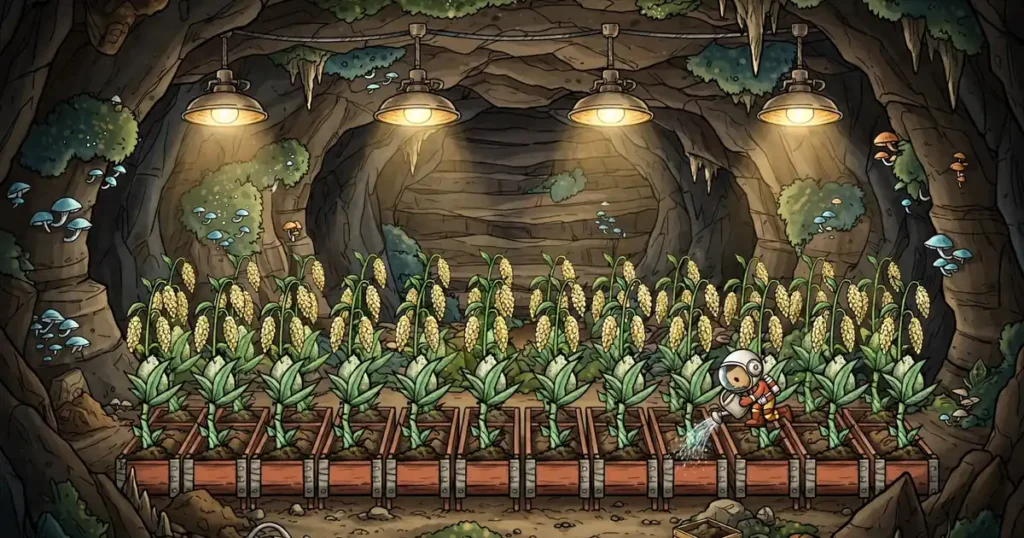
Your first farm should be mealwood. Planted in planter boxes, it produces meal lice, the simplest farmed food: poor quality and bad for morale, but reliable, needing no water, and enough while you research better options. A microbe musher turns meal lice into liceloaf.
This oxygen not included beginner guide also recommends storing food where carbon dioxide pools, since food there stays sterile longer, and building a ration box or refrigerator once you have power to spare.
Do not rush to bristle blossoms: they taste better and feed morale, but they need water and light, and water is also needed for research and oxygen, so plant them only after water is secure. Ranching hatches and growing mushrooms give better food later, but those are mid-game projects.
That order – mealwood first, better food second – is the food rule this oxygen not included beginner guide returns to whenever a new option tempts you.
Research Order: What to Unlock and When
SUMMARY: This section gives the research order used in this oxygen not included beginner guide: food, oxygen and power, advanced research.
Research unlocks better buildings, and order matters. Start with Basic Farming and Meal Preparation: farming gives planter boxes and algae terrariums, meal preparation gives the musher and better recipes. Food comes first because duplicants starve faster than they suffocate, and farms take cycles to grow.
Next, unlock power and oxygen support: generation improvements, batteries, and the buildings leading to the electrolyzer. Build the Super Computer, the advanced research station, once the basics are done; it consumes water as well as labour, so check water first.
By cycle 30 you should have core farming, power, and oxygen tech unlocked, with advanced research underway – and this oxygen not included beginner guide treats missed research days as normal, not failure.
Research order table (Step | Research | Unlocks): 1 | Basic Farming | Planter boxes, terrariums. 2 | Meal Preparation | Musher, recipes. 3 | Power/oxygen | Batteries, electrolyzer path.
| Step | Research | Unlocks |
|---|---|---|
| 1 | Basic Farming | Planter boxes, terrariums |
| 2 | Meal Preparation | Musher, recipes |
| 3 | Power/oxygen | Batteries, electrolyzer path |
Stress and Morale: Early Warning Signs
SUMMARY: This section explains how stress builds in this oxygen not included beginner guide, early warning signs, and cheap morale fixes that prevent breakdowns.
Stressed duplicants work slowly, eat more, and can break down, damaging the base or refusing orders. Stress rises when morale is low – bad food, no bedroom, no toilet, constant grime. Watch the morale panel and act before the stress bar fills.
The cheapest fixes are rooms: a real bedroom (cots, enclosed) and a real bathroom (outhouse plus wash basin, enclosed) give small morale bonuses. Then build a Great Hall – a mess hall with tables, a water cooler, a decor item – which gives a much larger bonus and is the best early investment in happiness.
This oxygen not included beginner guide also warns against taking extra duplicants too early: every new mouth needs food, oxygen, and morale, and a fourth before cycle 15 usually creates more stress than help. Take new duplicants only when food, oxygen, and morale are stable – a rule this oxygen not included beginner guide repeats because breaking it ends colonies.
Cycles 6-30: The Week-by-Week Plan
SUMMARY: This section turns the early game into a cycle-by-cycle plan in this oxygen not included beginner guide, so you always know what the colony should be doing next.
After five cycles, the colony settles into a rhythm. The table below is a realistic pace, not a speedrun: falling behind a few cycles is normal. Judge progress by stability, not cycle number.
Cycle plan table (Cycles | Goal | True by the end): 6-10 | Farm running | Farm feeding colony. 11-15 | Power and space | Coal power, no new duplicant. 16-20 | Water | Water, electrolyzer planned. 21-25 | Better living | Electrolyzer, Great Hall. 26-30 | Mid-game ready | Heat managed, research running.
| Cycles | Goal | True by the end |
|---|---|---|
| 6-10 | Farm running | Farm feeding colony |
| 11-15 | Power and space | Coal power, no new duplicant |
| 16-20 | Water | Water, electrolyzer planned |
| 21-25 | Better living | Electrolyzer, Great Hall |
| 26-30 | Mid-game ready | Heat managed, research running |
If You Own the DLCs: Spaced Out and Frosty Planet Pack
SUMMARY: This section separates the downloadable content from the base game in this oxygen not included beginner guide, so DLC owners know what changes and what stays the same.
Spaced Out changes the shape of the game: instead of one large asteroid, you start on smaller asteroids linked by teleporters, with rockets needed for the farther ones. Priorities do not change – oxygen, food, research first – but you manage small bases.
The Frosty Planet Pack adds a cold-weather starting option; the base-game opening still applies once your colony is running. If you own either DLC, keep it disabled for your first colony for the simplest version of this oxygen not included beginner guide.
Frequently Asked Questions
SUMMARY: These six questions answer the most common queries about the first 30 cycles.
When should I switch from algae to an electrolyzer?
Switch with a reliable water source, steady power, and the electrolyzer research finished. Until then, a diffuser plus terrariums will carry a small colony. This oxygen not included beginner guide recommends building the electrolyzer high in your base and handling hydrogen early.
How many duplicants should I have by cycle 30?
Three to five, only if food, oxygen, and morale are stable. A fourth around cycle 15 is reasonable once mealwood produces. This oxygen not included beginner guide warns against printing one just because the pod offers it: every extra mouth raises consumption at once, while the farm takes cycles to catch up.
Why is my base running out of oxygen?
The usual causes, in order: an overpressured diffuser, exhausted algae, too many duplicants. Check diffuser pressure, algae stockpile, then headcount. This oxygen not included beginner guide also recommends checking that oxygen can flow: sealed rooms and blocked airflow tiles starve parts of a base.
What is the best first food?
Mealwood, grown in planter boxes and harvested as meal lice. Not tasty, but it needs no water and grows reliably. This oxygen not included beginner guide treats bristle blossoms and ranching as upgrades to earn after water and research are secure, not starting foods.
How do I stop stress breakdowns?
Fix morale before stress fills the bar: enclosed bedrooms and bathrooms, a Great Hall with tables and a water cooler, decor, clean water, food. This oxygen not included beginner guide also recommends refusing extra duplicants until morale is stable: a stressed colony plus a new mouth is how breakdowns cascade.
Do I need the DLCs to enjoy the game?
No. The base game is a complete colony sim, and everything here works with no downloadable content. This oxygen not included beginner guide suggests learning the base game first, then adding Spaced Out or the Frosty Planet Pack once the loop feels familiar.
The first 30 cycles are about patience, not speed. Keep the colony small, solve oxygen and food first. Follow that order and your duplicants will reach cycle 30 with air, food, and a base ready for the mid-game – the foundation every later colony builds on, and the reason this oxygen not included beginner guide keeps month one simple.
For more survival and building coverage, see Atmosfar survival guide and Minecraft beginner tips, and the GameCresta homepage.
For the official word, see the Klei forums mid-game guide, VG247 beginner guide, Oxygen wiki page, and Steam community oxygen guide.
For More Updates Visits: GAME CRESTA






One Response